 |
|
|
Abkhazia leader says no talks
with Georgia without preconditions |
|
Moscow, The President of Abkhazia, Sergei Bagapsh, categorically dismissed on
Tuesday the possibility of negotiations with Georgian President Mikhail
Saakashvili without any precondition, to which Europe is urging.
“This will not happen,” he stressed in a newspaper
interview. “I know why they need tete-a-tete talks of the presidents -
in order to say then that Bagapsh and Saakashvili are meeting, and they
would have had normal relations if Russia had not interfered,” the
Abkhaz leader stressed.
“We won’t give them such a motive,” he said in an
interview with the Kommersant daily on Tuesday.
“After the war we had a constructive dialogue with
them, but the arrival of Saakashvili has put paid to it,” he stressed.
“These people don’ t understand that apart from the use of force there
are also negotiations. They don’t understand that South Ossetia and
Abkhazia are not boys in short pants, but full-fledged partners in
negotiations,” Bagapsh emphasized.
Bagapsh also specified that Abkhazia does not link
“its fight for independence with the recognition of Kosovo”. However, it
such decision on Kosovo is approved, “it will untie the hands of other
states for the recognition of Abkhazia, the Dniester region, Nagorno
Karabakh and South Ossetia,” he believes.
07.31.2007
Itar-Tass
|
|
Abkhazia
to be satisfied with the report of the Secretary-General - MFA Shamba |
|
Abkhaz side is fully
satisfied with the report of the UN Secretary-General Ban Ki-moon issued
today, Foreign Minister Sergei Shamba reported in an interview with the
Official website of the President.
According to him, the UN
Secretary General reflected in the report all the points, at which
official Sukhum focused at the meeting of the “Group of Friends” in Bonn
(Germany), held about a month ago.
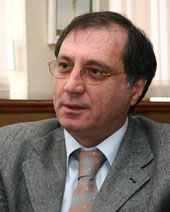
"Our concern over the situation in the upper Kodor Valley was adequately
received by the international community. And those points that were
outlined in the report of the "Group of Friends" appeared in the report
of the UN Secretary General, and we are certainly pleased," said chief
diplomat of Abkhazia.
"We are also glad that
the international community has explicitly stated that the Georgian side
must move the youth camp near the border with Abkhazia in another place,"
said Shamba.
Sergei Shamba hopes that
the international pressure on Georgia in connection with its desire to
escalate tensions will grow.
"Even though a month has
already passed since the meeting in Bonn, real steps to implement the
agreement that we have reached there have not started. Georgia continues
to ignore the suggestions of the international community," stressed the
Foreign Minister.
According to Shamba, it
is primarily on the joint investigation into the kidnapping in the Gal
region of a citizen of Abkhazia David Sigua.
The investigation team
has not yet started its work.
07.24.2007
Abkhazia.gov.org
|
|
Abkhazia puts
focus back on homecoming |
|
Sukhum, Agency
CaucasusThe Abkhazian administration places focus on homecoming from
Diaspora over again after earlier official attempts failed to meet
expectations.
The Abkhazian
Parliamentary Committee for Return held a meeting in an effort to draw
up a newer official program of encouragement for future returns from
Diaspora.
The committee meeting
promoted a proposal to meet the needs prior to the settling of Abazins
as a whole.
Words of support for
anyone who wants to return to Abkhazia came from the Parliament Speaker
Nugzar Ashuba when he proposed that further work with schooling both at
college and university levels should be developed.
Soner Gogua, an
Abkhazian member of the parliament of Turkish descent, who acts as head
of the committee, was heard to place emphasis on the need to provide
accommodation as well as employment for returnees.
Information about
returnees came from Anzor Mukba, Head of the State Committee for
Demography and Return. He quoted a total of 571 families as being
officially accommodated from 2005 to 2007. Those families include the
Abkhazians who came both from and Batum, and the Abazins who came from
Karachay-Cherkessia, Kabardino-Balkaria and . A group of 282 people
switched in 2005 to Abkhazian citizenship, 1246 in 2006 and 122 in 2007.
Most returnees are
seeking a place to occupy in the capital city of
Sukhum.
Returnees have to agree
not to sell their houses for the next 15 years if they want to be
officially accommodated.
One of the participants
at the committee meeting was Sergei Shamba, Foreign Minister of
Abkhazia. He delivered to other participants some information both about
the Georgian Group of Friends meeting at the headquarters of United
Nations (UN) Secretary General and his talks with several officials
about Abkhazian Diaspora.
A returnee of Turkish
descent captured in
Tbilisi
Gogua asked Shamba for
help with the release of a returnee of Abkhazian citizenship when he
spoke about an incident in which Georgian front guards arrested members
of a crew on a Turkish vessel while it was carrying coal from Abkhazia.
07.19.2007
Agency Caucasus
|
|
Shamba returns
with words of promise |
|
Sukhum, Foreign
Minister Sergei Shamba of Abkhazia returned with positive words from the
meeting of Georgia’s Group of Friends at the headquarters of United
Nations (UN) Secretary-General.
Shamba told reporters
that his talks with officials across Germany left him with the
impression that there is nowadays a far more positive view of the
Abkhazian demand for recognition.
“Even those who would
think it impossible for Abkhazia to gain recognition of independence now
tend to have a change for better in their outlook,” the official news
agency Apsnipress quoted Shamba as saying.
The June 27 and 28
meeting of Georgia’s Group of Friends in Bonn was far better in
comparison with previous meetings, said Shamba. This group enables
negotiation with Georgians, he added.
“Talks of this kind
give us one importance chance of expressing our own position. All
criticism went to Georgia during the entire meeting. There was also
discussion over Georgian willingness to withdraw from Kodor as a prior
condition for resumption in talks,” Shamba said.
Good news about
Turkey
Talks at the meeting
focused at one moment, said Shamba, on the surprising possibility of
creating between Sukhum and Trabzon a means of marine transportation by
which the Abkhazians in Diaspora can maintain contact with their
homeland.
“One of the items that
appeared on the list of to-dos after the meeting ended was the
establishing of transportation between Sukhum and Trabzon. The Georgian
proposition that vessels must stop by the ports of both Poti and Batum
for controlling was rejected. Another Georgian proposition that vessels
must be controlled within the waters of Georgian border security was
also rejected. These two rejections helped us to maintain firmly that
vessels must be controlled by the Abkhazian border security, along with
assistance from United Nations (UN) military observers as well as the
Peace Forces of the Commonwealth of Independent States (CIS).”
Shamba spoke for
Abkhazia when he said his government seeks continuation of peace talks
under UN supervision.
Abkhazian
Diaspora most active in Germany
Germany was defined in
Shamba’s words as the central European country where the Abkhazian
Diaspora is most active as he expressed growing optimism for the future
after he met in Düsseldorf with a large group of participants from
several European countries.
07.18.2007
Agency Caucasus
|
|
Preparations
under way in Abkhazia for chess festival |
Sukhum, Abkhazia is preparing for
the next international chess championship as a series of games played
among contestants from across the Commonwealth of Independent States
(CIS).
As many as 400 contestants, including
12-20 professional chess players who formerly gained titles, will take
part in August in the fourth festal Abkhazia OPEN Sokhum-2007 chess
championship.
The organization one before attracted
participation of 141 players from Russia, Belarus, Uzbekistan and
Abkhazia.
“This will be one of the most
significant festival of chess games across the CIS countries. Famous
chess players from Ukraine, Kazakhstan and Uzbekistan will compete to
win the Abkhazia-2007 championship. All Russian republics will have
the chance to be represented at the festival. A group of 30 from
Tatarstan and famous chess players from several North Caucasian
republics will join the festival, too. The entire Chechen team of
chess players will be present under the leadership of Ruslan
Yandarbiyev for the festival,” said Konstantin Tujba, Head of the
Abkhazian Chess Federation.
Tujba also said that some chess players
who have joined in Vancouver the Canada Open 2007 championship seem
eager to join the Abkhazia chess festival. Information about and
photographs of the entire festival will be accessible at
www.abkhaziachess.ru.
This organization of chess games will hopefully revive the old public
habit of playing traditional games. The Abkhazian chess festival was
first organized in 2004, when only 12 players from Abkhazia attended
the competition. This year’s participation from Abkhazia is 25.
The name of Yuri Chanba will also be
commemorated in a tournament as part of this chess festival, since
Chanba worked hard in Abkhazia to expand chess.
The Abkhazia OPEN Sokhum-2006 ended with
Boris Savchenko from Krasnodar winning the first position at the
championship, with Roman Ovechkin from Nijnii Tagil winning the second
position, and with Yuri Tikhonov from Belarus winning the third
position.
07.15.2007
Agency Caucasus
|
|
TV channel to be set
up in Abkhaz district - official |
|
Moscow, A local television channel
will be set up in Gal, a district in Abkhazia that lies along the
Georgian border and includes a demilitarized zone patrolled by Russian
peacekeepers, a senior Abkhaz official was quoted on Wednesday as saying.
The channel would broadcast in the Russian,
Abkhaz and Megrelian languages, the Abkhaz president's official website
said, citing Ruslan Kishmaria, his envoy to Gal district and chief
Abkhaz negotiator with Georgia. There is a large Megrelian community in
Gal, the bulk of whose population are ethnic Georgians.
"It is an essentially new project, one
that we have been planning to put into practice for several years. This
project is of strategic significance in the sense of the integration of
the district into the space of Abkhazia," the site quoted Kishmaria as
saying.
The channel would broadcast daily news
bulletins "about the life of the area and the entire country," Kishmaria
said.
07.11.2007
Interfax
|
|
Parliament discussed
measures to enhance safety of higher officers |
|
Sukhum,
The National Assembly in the first reading adopted changes in the
legislation governing the protection of the higher authorities.
The Parliament intends to strengthen protection
of senior government officials.
The Parliament of Abkhazia adopted in the first
reading amendments to the Administrative Code, prohibiting the use of
vehicles with tinted windows. If the law is adopted only official
government vehicles will be allowed to move with tinted windows.
Conditions of coloring glass of citizens’ cars will be discussed in
further readin.
07.11.2007
abkhaziagov.org
|
|
Parliament
adopted laws on state emblem and flag of the republic of Abkhazia |
|
Sukhum,
People's Assembly-Parliament of Abkhazia adopted in the final reading a
new version of the State emblem and flag of the Republic of Abkhazia. So
far, laws on national symbols of 1992 and 1994were acting.
"Projects of
constitutional laws do not change the existing state flag, emblem and
anthem, they are to regulate the use and application of the official
state symbols and their legal protection", said senior officer of the
law and economics department of the Presidential Administration Dmitri
Shamba to the Official Site of the President. In particular, it is
provided that the State flag to be raised and the National Emblem to be
placed on the buildings: the Presidential Administration, the People's
Assembly-Parliament, the Cabinet of Ministers, the Supreme Court, the
Arbitration Court, the General Prosecutor's Office, National Bank, as
well as the buildings of the public administration and local
self-government bodies.
07.11.2007
abkhaziagov.org
|
|
Terror act in
Gudauta to be threat to the statehood of the country - Government |
|
Sukhum,
The
government of Abkhazia issued a statement in connection with the
assassination attempt on Prime Minister Alexander Ankuab, in which the
terror act in Gudauta is called threat to the statehood of the country.
The Cabinet of Ministers
stressed that the attack on Prime Minister threatens to destabilize the
situation in the country and eventually work for the interests of those
who are interested in the elimination of the statehood of Abkhazia.
Earlier almost the entire
political spectrum reacted to the terror attack that took place in
Gudauta. The statements were distributed by the parties "United Abkhazia",
"Amtsakhara", "Aitaira", and the Popular Unity Forum, which units a
group of opposition political forces.
Political forces claimed
from the law enforcement agencies effective investigation and to bring
those responsible to justice.
A number of political
movements appealed to the President and to the law enforcement
authorities demanding to the suspend law enforcement officers, the work
of which is unsatisfactory.
Today, the President
Sergei Bagapsh will meet with the country's political forces to discuss
the situation in the country in connection with the assassination
attempt on the Prime Minister.
07.10.2007
abkhaziagov.org
|
|
Abkhaz Premier
Attacked |
|
Sukhum, Unidentified assailants
opened fire on a car carrying the prime minister of Abkhazia on Monday,
lightly injuring him, officials said.
A grenade launcher was apparently used in
the attack on Alexander Ankuab, who has survived three assassination
attempts since he took office in early 2005, said Abkhazia's top police
official, Otar Khetsiya. There was no word on suspects or a motive.
Ankuab's car came under fire in the
morning while en route to Sukhum, the capital of the Black Sea republic,
Khetsiya said.
Ankuab said a grenade hit the trunk of the
car, Interfax reported. He said he had shrapnel wounds in his back and
was shaken up by the blast, but that nobody was seriously injured in the
attack. (AP)
07.10.2007
The Moscow Times
|
|
There are forces
in Abkhazia which prevent reforms and against organized crime -
President |
|
Sukhum,
Head
of State made a statement in connection with the assassination attempt
on Prime Minister Alexander Ankuab.
The President announced a
compensation of 500,000 rubles for information that will help to
disclose the crime.
"Repeated attempts to
remove the Prime Minister of the country indicate only one thing : there
are certain groups that are actively trying to prevent the
transformations started in the republic, to prevent the work of the
president’s team, aimed at economic reforms and fight against organized
crime", the Head of State believes.
"Perhaps, this way these
people are trying to destabilize the intra-social situation in Abkhazia.
Consciously or not, but in doing so, they perform a political order of
our opponents, the country that Abkhazia is in a state of war with,"
said the President of the Republic.
Sergei Bagapsh stressed
that the authorities can not be intimidated, and they will not desist
from path of reforms and development. "The government's policy will not
change, and such kind of “pressure" will not "force the government of
the Republic to walk away from the chosen path," said the President of
Abkhazia.
07.09.2007
abkhaziagov.org
|
|
Georgia to
disrupt negotiating process - MFA |
|
Sukhum,
Ministry of Foreign Affairs of Abkhazia sent a note to the Special
Representative of the UN Secretary General Jean Arnault and the Friends
of the UN Secretary-General about the actions of the Georgian, which are
threatening the negotiating process and security in the region.
Abkhazia is concerned
with the capture of the Turkish vessel that was carrying a cargo of coal
from the port of Ochamchira.
As the Foreign Ministry
of Abkhazia states, Georgia uses a mechanism of negotiating process as a
cover for military and political provocations.
The Abkhaz FM calls on
the international community to respond to the actions of Georgia,
undercutting the negotiating process and violating stability in the
region.
"In such circumstances,
the lack of an adequate response from the mediators in the negotiation
process may indirectly encourage aggression of Georgia, which could lead
to a new conflict", said in the note of the Abkhaz Foreign Ministry.
Official Sukhum requests
the Group of Friends of the Secretary-General of the United Nations to
help to release the Turkish ship and its crew members seized by the
Georgian side.
07.09.2007
abkhaziagov.org
|
|
Heads of Abkhazia
and South Ossetia to focus on situation in conflict zone at Moscow
meeting |
|
Moscow, The presidents of the
republics of Abkhazia and South Ossetia, Sergei Bagapsh and Eduard
Kokoity, will discuss the situation in the Georgian-Ossetian conflict
zone at a meeting in Moscow on Monday.
The situation in the conflict zone remains
tense. "The Georgian side is not stopping provocations aimed at
aggravating the situation," Bagapsh said.
"Once again I am inviting the Georgian
side to sit down at the negotiating table and to deal with the existing
problems within the framework of earlier reached understandings,"
Kokoity said.
07.09.2007
Interfax
|
|
"Kosovo disease"
threatens international law |
|
Moscow, by
Piotr Romanov, International law, which
has never been in good health, is on its deathbed once again, not long
after almost succumbing to a grave illness provoked by Washington's Iraq
war launched in stark disregard of the UN Charter.
The new disease is called Kosovo. Cristina
Gallach, the spokesperson for Javier Solana, the European Union's High
Representative for the Common Foreign and Security Policy, said the EU
would take matters into its own hands and make a decision on Kosovo if
Russia continued to say "no."
"Russia has maintained its position, but
Kosovo is a European problem," Gallach said in an interview published in
the popular Serbian newspaper Vecerne Novosti Tuesday.
"The Balkans' future depends on Europe,
not Russia. Therefore, the EU will make a decision if need be, but only
with the UN Security Council's consent," Gallach said, according to RIA
Novosti.
Russia threatened to veto a UN Security
Council resolution that would effectively set the Serbian province,
which has a majority ethnic Albanian population, on the path to
sovereignty.
Since Russia's right of veto cannot be
revoked according to the UN Charter, and the stance of Moscow and
Belgrade on the Kosovo problem is firm, Gallach's words can only mean
that the EU plans to ignore Russia's veto, the UN Charter, and the
principle of the inviolability of borders which has guided the
international community since World War II.
I don't know for sure if Ms. Gallach has
adequately interpreted the position of her boss and the EU as a whole,
but if she has, then the EU policy is misguided.
How long will the UN live if everyone
starts violating its charter?
The EU has no regard for Serbia either, as
it believes the Serbs are guilty of bringing forth Slobodan Milosevic
and must therefore be made to pay for their blunder. (I wonder what
would have become of Germany if the international community had assumed
a similar stance regarding Germans for allowing Hitler to come to power?)
The advocates of sovereignty for Kosovo
close their eyes to the fact that there are many similar hot spots in
Europe. They believe that the policy of double standards is the only
correct one, that Kosovo is unique, and no parallels can be drawn with
Abkhazia, South Ossetia and Transdnestr, breakaway republics in the
former Soviet countries of Georgia and Moldova.
Ms. Gallach has not taken time to think
that the people in those republics are no less deserving than Kosovo
Albanians. Geography is the only thing she cares about. For her, Kosovo
Albanians have a right to independence because Kosovo is adjacent to
Western Europe, whereas Abkhazia, South Ossetia and Transdnestr border
on Russia and hence have no right to independence.
Milosevic's unwise policy provoked a
never-ending exodus from the Balkans, with Albanians fleeing the wrath
of Serbians and later coming back to slaughter them. Tentative estimates
say 200,000 people have fled the province.
How many more will have to abandon their
homes if the European bureaucrats get their way? There are 180,000
non-Albanians in Kosovo, all of them potential victims or refugees. Who
will guarantee their security if Kosovo gains independence, especially
since the province has already become Europe's "gray zone" controlled by
criminals and drug barons?
Will the EU, which has failed to rid
Kosovo of drugs, protect its women and children who are not Albanians or
Muslims? Have we forgotten about the cowardice of the Dutch peacekeepers,
whose "lack of initiative" helped set the stage for the mass killing in
Srebrenica? None of them have been called to account.
Have European politicians ever thought
about the "Kosovar identity," which can be interpreted as the dream of
Kosovo's Albanian extremists to take over the adjacent European regions
predominantly populated by Albanians? Have they noticed that this will
concern the territorial integrity of Macedonia, Montenegro and northern
Albania? So, Serbia is not the only country concerned here.
In other words, Kosovo is not ready for
independence politically, economically, or in terms of security. Neither
are Serbia, Russia, and Europe ready for it to be independent. The only
ones who claim to be ready are irresponsible EU bureaucrats, Albanian
nationalists, and the Bush administration. But Washington also claimed
to be ready for the Iraq war, if I'm not mistaken.
The old order is crumbling before our very
eyes. Russia has firmly upheld the territorial integrity of Georgia and
Moldova, in line with international law and even though its relations
with these states are far from ideal. What should it do now, support
separatist tendencies on its border? Or withdraw from the UN?
This reminds me of the demise of the
League of Nations and of the run-up to World War II.
The opinions expressed in this article
are the author's and do not necessarily represent those of RIA Novosti.
07.04.2007 RIA Novosti
|
|
PACE
Chief Begins South Caucasus Tour |
|
The president of the Council
of Europe's Parliamentary Assembly (PACE) is scheduled to start today a
tour to the South Caucasus.
Rene van der
Linden said the main goal of his trip to Armenia, Georgia, and
Azerbaijan is to look at ways to settle the frozen conflicts in South
Ossetia, Abkhazia, and Nagorno-Karabakh.
He will first
visit Armenia and Georgia, including a July 7 visit to South Ossetia. He
then moves on to Azerbaijan for July 8-10.
07.04.2007 Itar-Tass
|
|